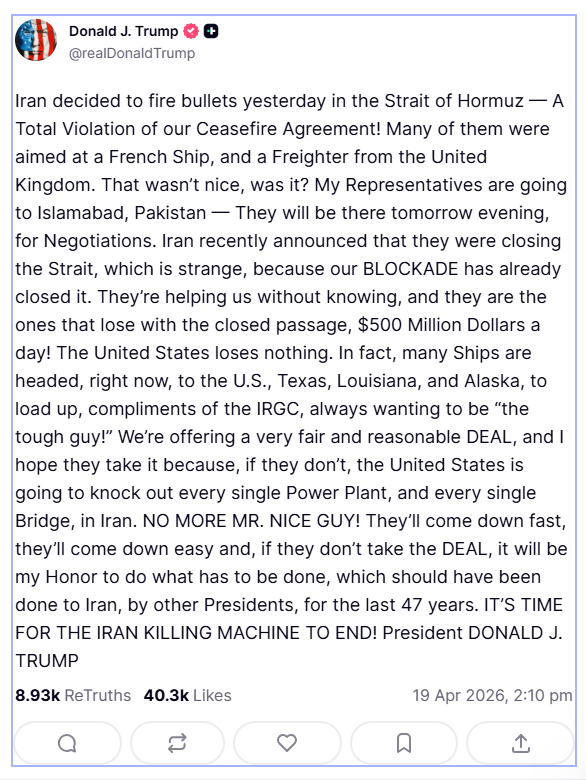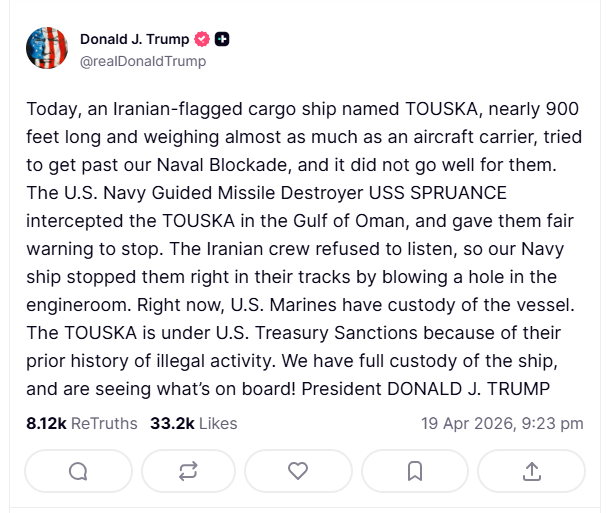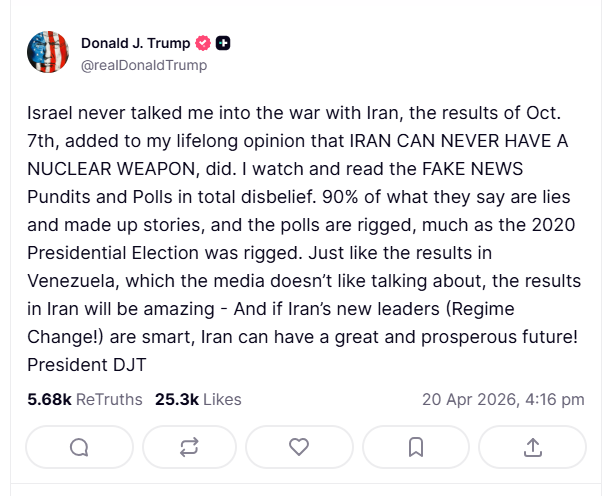


Threatening negotiation style
one thing has been apparently uh at least partially resolved and that is the dispute over whether Lebanon is part of the makebelieve ceasefire that was announced a bit back a while ago. The answer is yes, it is. and Donald Trump has now prohibited Israel from conducting further aggressive operations there. That isn't stopping the Israelis, by the way, from violating the new so-called ceasefire in Lebanon. But it does answer the Iranian condition that there be a discussion and arrangement for a regionwide peace, not just one between the United States and Iran or Israel and Iran.
[. . .]
a substantial part of the United States Navy is now in the Arabian Sea or the Gulf of Oman conducting a blockade. And we're hearing reports that conditions aboard the ships are deteriorating rapidly, that the crews do not have access to basic necessities, that food is running out, that systems are breaking down. And this is not a formula for a long-term sustainment of a blockade.
[. . .]
this is uh yet another example of fantasy foreign policy. that is foreign policy by media manipulation rather than by a serious effort to reach an understanding with the other side. We've seen this pattern again and again and again. We've seen it in Ukraine with the talks in Moscow. We've seen it in Gaza with the phony ceasefire there. We've seen it and now in Lebanon. We've seen it with Iran. No, it is not usual. It is not usual to declare an agreement when there is none.
[. . .]
what we saw in Islamabad in the meeting between JD Vance and Mr. Alibaf and and Arachi the foreign minister of Iran was not a negotiation. It was an American performative act intended to imply that there was a negotiation, which didn't exist. The Iranian side arrived with 70 or so people in their delegation with the full authority apparently of the authorities in Tehran including the IRGC, the Islamic Revolutionary Guard, to conduct a serious negotiation and reach agreement. They had technical staff with them who were prepared to discuss issues in detail. The American side was heavy on politically connected people and very low on experts and it was essentially there to present an ultimatum
[. . .]
the purpose of war is to achieve adjustments in relations and policies. that is a political result. Not simply to cut up the enemy and inflict suffering on the enemy. So Iran has shown that it can take an enormous amount of punishment and continue to fight. This strategy as I've mentioned before was the same as Muhammad Ali, rope a do strategy, that is allow the enemy to punch you as hard as it could in the effort to exhaust it. and weaken it and to wait for the moment to deliver your own counter measures and counter blow.
[. . .]
the demographics in Lebanon have changed fundamentally. And now Shiites are a majority and the major force in Lebanese politics and representation in parliament, is not just an army. It's a political movement, the political party with enormous authority. And in many ways it's fascist. I'm not very fond of it. I mean it does it is a state within a state. And performs a lot of functions for those under its authority that the government can't perform. But one of those functions is the defense of Lebanon as a state against Israeli aggression which the Lebanese army is incapable of doing. So here we have a talk between Hisbolah of course is not part of these talks. It has repudiated them to claim that they're illegitimate and that it won't be bound by them. it will take advantage of anything that comes out of them of course if it can but essentially we have a Lebanese government which is threatened by Hisbolah domestically and it used to deal with this issue by cleaving to Iran who was part of an Iranian Hisbolah operated sphere of influence now it's trying to replace Iran with Israel basically enlist Israel against Hezbollah and Israel's purposes are very clear. They want to destroy Hizbollah and disarm it. They and by doing so they would remove any obstacle to their military operations in Lebanon. And it's very clear that in southern Lebanon they've blown up all the bridges over the river and other rivers severing Lebanese south from the rest of the country. They are applying the model of Gaza to that region. That is destroying physical infrastructure, murdering anyone who they can hit, they can strike and driving people out. Unlike Gaza, people in Lebanon have somewhere to go. You know we've had some very, I should say, frightening objectionable statements from people like Jared Kushner about why don't we just bulldoze part of the negative desert and move all the gazins there, but the fact is the gazins have stayed put the Lebanese have not. They have moved out now they're coming back and Israel has actually established a paralle to the so-called yellow line in Gaza, an invisible border. And it shoots people who cross that border because it declares them to be terrorists, because otherwise why would they be crossing the border? I mean, they must have something nefarious in mind, you know, maybe they're just trying to get home. But anyway, so what we're seeing in southern Lebanon is a repeat of Gaza. And that should be pretty sobering because it suggests that Gaza was not an aberration. It's a pattern that Israel proposes to impose on other areas that it chooses to annex. And of course, it is a state with the unique, it has no borders, no agreed frontiers whatsoever. Constantly expanding. This falls short of the definition of the normal definition of a state. So Lebanon is a great caution in many ways. But what's going to happen there? My guess is that we will see a repetition of Gaza then that is to say a phony ceasefire, will not be, will will cause, will Israel insist that everyone else cease fire while it continues to fire at them and to pursue its strategic objectives and this is probably going to lead to some kind of blow up between the Trump’s administration and Israel or more likely the capitulation of Donald Trump to his Israel Israeli minders.
[. . .]
his [Donald Trump’s] training in New York real estate had two elements. One was that you made deals by through coercion bullying. Now, you threatened to bankrupt or ruin your proposed partner in a deal, and that's how you got a deal. That was Roy Conn's lesson to Donald Trump. You never accept defeat. You always punch back. You don't have any regard for the facts. you make up facts because the court of public opinion is more important in the real estate context perhaps in New York than the underlying reality. Unfortunately for Donald Trump that is not true internationally. The reality persists even if you misdescribe it or ignore it. Second element in his training is that when you get in trouble you declare bankruptcy and walk away with no obligations. And that's what he'd like to do with the Persian Gulf. That's why I'm so surprised that he didn't have the wit to accept the Iranian opening of the straight as a victory.
[. . .]
one of the amazing things about the roller coaster we've been on in this war is the gullibility of so many people. I mean look at Trump's ability to manipulate the market. Quite extraordinary. And people's wishful thinking that the best is about to occur because Donald Trump proclaimed it would is really remarkable. I've never seen anything quite like it. And I'm a minor investor. Having emerged from my government service penniles, I've been trying to rectify that condition with some success. So I follow the market and it is very much manipulated by this charismatic slightly insane, maybe more than slightly insane, man in the in the White House.
everything looks like it's coming to a head this coming week. It looks like that we're going to resume the war and I really don't need any resources for this or any kind of insider information. You can just see from the public statements and then you can see from the physical movement on the ground that there's problems
[. . .]
if we escalate in terms of the types of targets hit, they will escalate in their response. And this could be catastrophic for the global economy. It's one thing if you have a political decision to stop the flow of oil. A decision was made to block the straight of Hormuz. That can just be a political decision to unblock it and the thing can go over. But if you have a physical constraint because of an attack and you destroy oil production facilities, it could take years to recover from all that. And then you have the I think that already many of the experts have been on our show to talk about this. We've seen others. We already have baked in a recession. I think because even if the straight opens tomorrow and it won't it's going to take months to unwind all the problems here to get the flow even close to being back to what it was before what the global demand requires and so a lot of these problems that are going to be baked in and I've talked about food with fertilizers etc. a lot of problems. That's right. Now, you take this course of action and you expand the target set and you expand the war and you expand the consequences of the war. We're talking the likelihood then of a depression. And it's unclear how we're going to get out of that one. That's where we are, folks. This is a critical critical juncture in this this whole war so far. If we escalate and take it up another notch instead of doing the rational thing, the only way that can limit the damage, which is a negotiated settlement on the best terms that we can get, which are going to be ugly, and it's going to require eating a lot of crow and showing some humility that we've never shown, the opposite of what President Trump said an hour ago.